Unlock Your Child’s Hidden Calm: The Simple Sensory Secret to Better Behavior
Is it “Won’t” or “Can’t”? Decoding Behavior
Imagine a Saturday afternoon at a crowded mall. A six-year-old suddenly drops to the floor, screaming because his mother asked him to put on his shoes. To the passing shoppers, it looks like a “won’t”— a clear case of a child being stubborn or “manja.” Specifically, they see a lack of discipline and a parent losing control.
However, let’s look closer at the child’s world. The mall lights are flickering at a frequency his brain cannot ignore. Furthermore, the echoes of a hundred conversations feel like physical needles in his ears. Consequently, the simple request to “put on your shoes” isn’t a power struggle; it is the final straw for a nervous system that has run out of space.
Behavior vs. Sensory Breakdown
We often mistake a neurological “can’t” for a behavioral “won’t.” True defiance is a calculated choice to break a rule. Conversely, sensory overload is an involuntary physiological shutdown. Specifically, when a child is overwhelmed, their “thinking brain” goes offline. Because of this, they lose the ability to access the skills they usually have. They aren’t choosing to be difficult; they are struggling to survive a moment that feels threatening.
The “Naughty” Myth
In our local culture, we often equate “good” parenting with immediate obedience. Because of this pressure, we feel a sense of failure when our children “misbehave” in public. Yet, labeling a child as “naughty” for a sensory meltdown is like punishing someone for sneezing during a hay fever attack. What we label as ‘spoiled’ or ‘manja’ could have been a child whose internal resources are completely depleted. Specifically, it doesn’t teach a skill; it only teaches the child that their internal struggle is a moral failing.
Meeting the Moment
When we decode behavior correctly, our response shifts from punishment to support. Meeting your child where they are—rather than where you want them to be—changes the entire family dynamic.
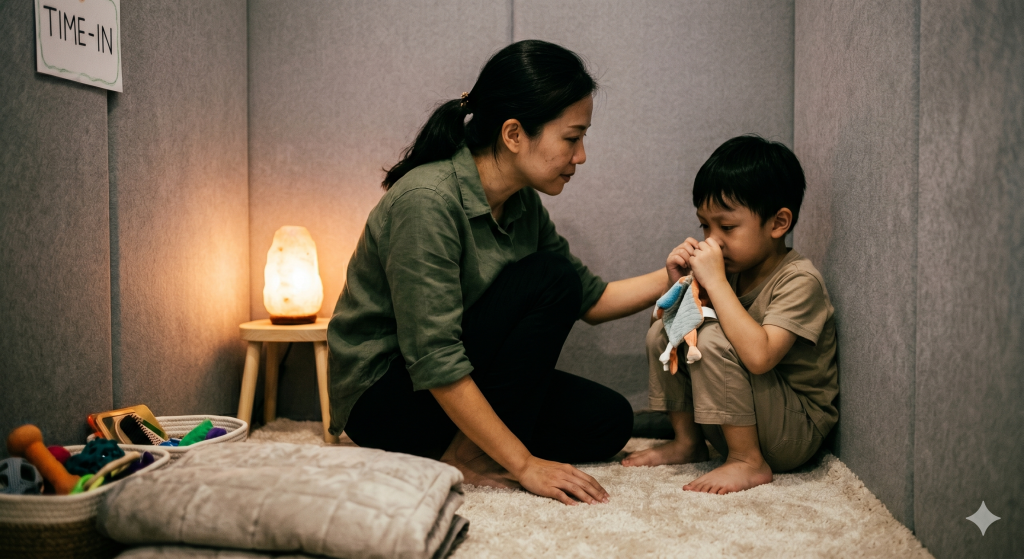
For the “Can’t” (Sensory): Instead of a time-out, try a “time-in.” Move to a quiet space and lower your voice. Specifically, reduce the input until their nervous system feels safe again. By doing this, you show them that you are their partner in the struggle, not another source of stress.
For the “Won’t” (Behavioral): If it truly is a choice, set a boundary that focuses on the task at hand. Use clear, simple language that addresses the action without attacking the child’s character.
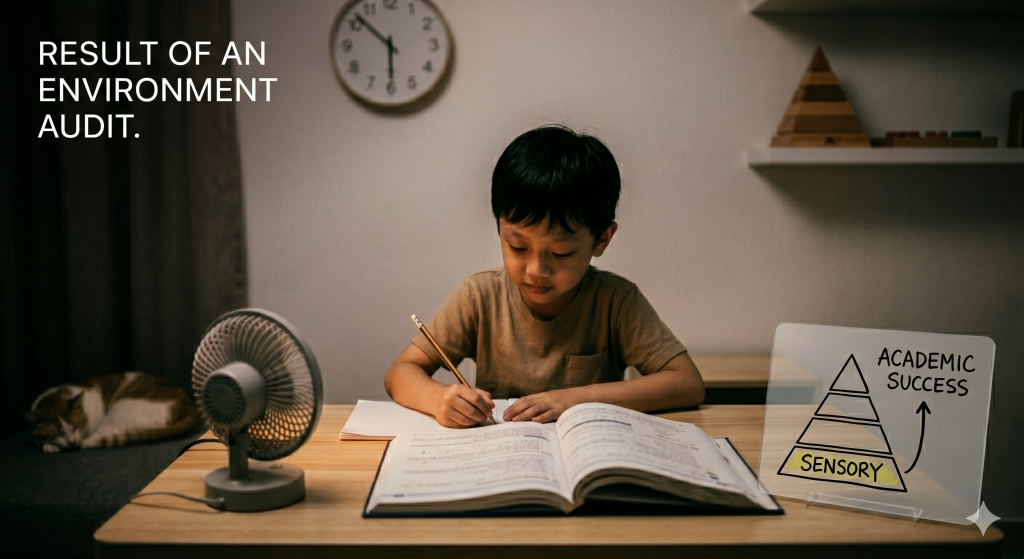
Tonight, try an Environment Audit. Identify just one “noisy” trigger — perhaps a loud fan, a flickering light, or a blaring TV — and turn it off during homework. You may find that when the environment stops attacking their senses, the “naughtiness” disappears on its own.